SYSTEMIC PEDAGOGY

Systemic Pedagogy in the IB® Framework: A Holistic Educational Approach Inspired by Bert Hellinger

Education is not only a cognitive process. Every classroom is also an emotional, relational and systemic environment in which students unconsciously carry family narratives, cultural identities, loyalties, exclusions and inherited patterns.

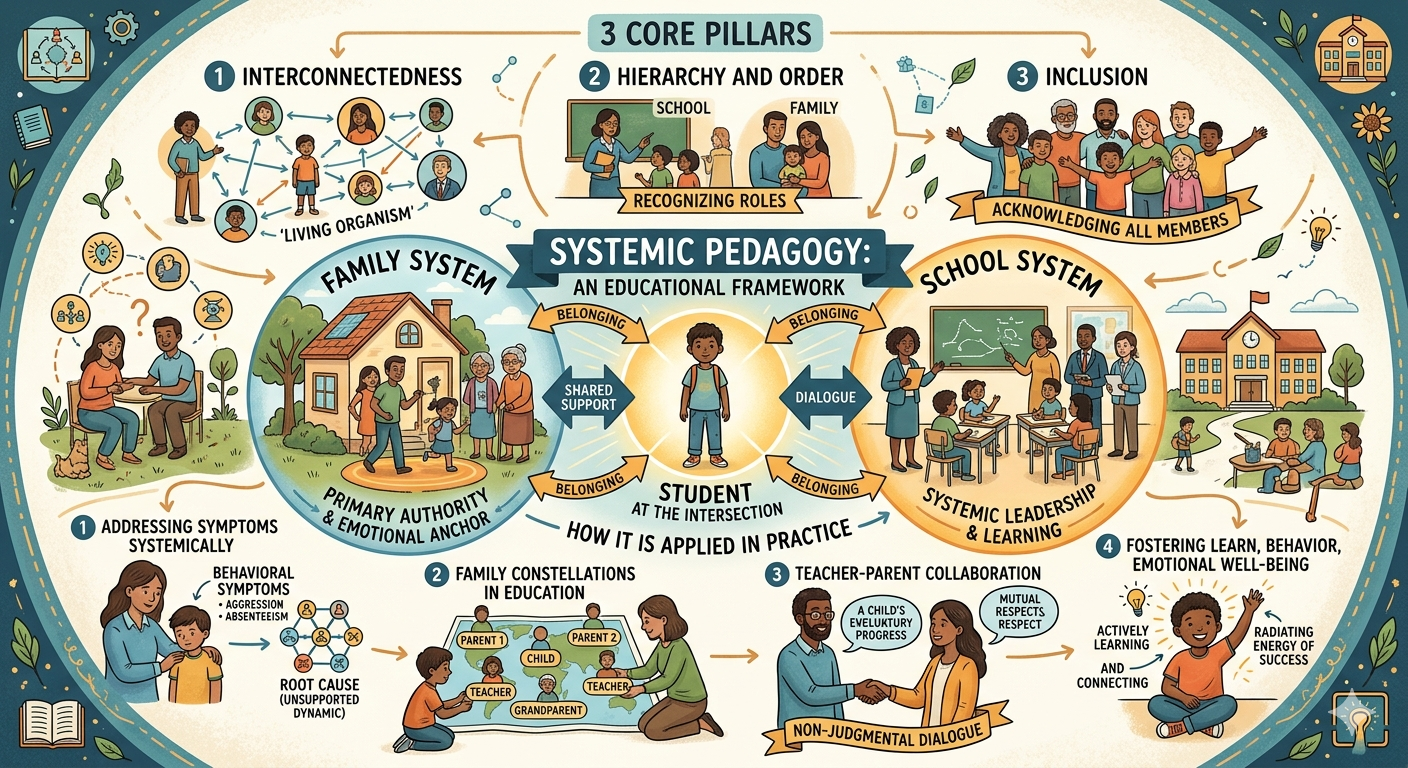
Systemic pedagogy, inspired by the work of Bert Hellinger, invites educators to observe students not as isolated individuals, but as part of wider relational systems: family, culture, school, history and community.

Within the context of the International Baccalaureate® (IB), systemic pedagogy offers a meaningful framework for supporting holistic development, emotional awareness, intercultural understanding and authentic belonging.

The IB® philosophy already emphasizes educating the “whole child” and nurturing intellectual, emotional, ethical and social growth. Systemic pedagogy deepens this approach by helping teachers understand the hidden dynamics that influence learning, behaviour and relationships inside the classroom.

What Is Systemic Pedagogy?

Systemic pedagogy is an educational approach rooted in systems thinking and influenced by systemic therapies, phenomenology and intergenerational family studies. It explores how learning and behaviour are connected to:

  • family dynamics,
  • belonging,
  • emotional inheritance,
  • intergenerational experiences,
  • social roles,
  • identity and relational positioning.

The approach was significantly influenced by Bert Hellinger’s concept of the Orders of Love,” which describes relational principles operating within human systems. These principles include:

  • the need for belonging,
  • respect for hierarchy and order,
  • balance between giving and receiving,
  • acknowledgement of excluded or forgotten members of a system.

In educational settings, systemic pedagogy asks an essential question:

“What might a student’s behaviour be expressing within the larger relational system?”

Rather than focusing exclusively on correction or academic performance, educators learn to observe context, relationships and emotional positioning.

The Theoretical Foundations of Systemic Pedagogy

Systemic pedagogy integrates insights from multiple psychological and systemic traditions that transformed educational and therapeutic thinking during the twentieth century.


Bert Hellinger and the Orders of Love

Bert Hellinger’s work explored recurring patterns within human systems and the consequences of exclusion, unresolved grief, interrupted bonds and imbalance. According to Hellinger, individuals function more harmoniously when:

  • everyone has a place within the system,
  • relational hierarchies are respected,
  • there is balance in relationships,
  • excluded members are acknowledged.

Within education, these ideas encourage teachers to consider how hidden relational tensions may influence:

  • student behaviour,
  • motivation,
  • emotional regulation,
  • social interaction,
  • academic engagement.

Marianne Franke-Gricksch and Systemic Work in Schools

Marianne Franke-Gricksch was one of the first educators to directly apply systemic work within schools. Her contribution remains fundamental to systemic pedagogy today. After years of teaching experience, she integrated systemic thinking into educational contexts, focusing particularly on:

  • teacher-student relationships,
  • family-school dynamics,
  • emotional belonging,
  • classroom harmony,
  • adolescent identity development.

Her work emphasized that students cannot be fully understood outside their relational systems.

Virginia Satir and Family Systems Awareness

Virginia Satir, one of the founders of family systems therapy, profoundly influenced systemic educational thinking. Satir believed that:

  • communication patterns shape emotional wellbeing,
  • self-worth affects learning and relationships,
  • family dynamics influence identity and behaviour,
  • authentic connection supports growth and healing.

Her humanistic perspective contributed to educational approaches that prioritize:

  • empathy,
  • emotional literacy,
  • communication,
  • relational trust.

Murray Bowen and Intergenerational Systems Theory

Murray Bowen introduced the idea that individuals are deeply interconnected within multigenerational emotional systems. His theory emphasized:

  • emotional triangles,
  • differentiation of self,
  • family projection processes,
  • intergenerational transmission patterns.

Bowen’s insights support a broader understanding of:

  • emotional regulation,
  • behavioural repetition,
  • student stress responses,
  • relational patterns within schools and classrooms.

Why Systemic Pedagogy Fits Naturally Within the IB® Philosophy

The IB® framework already contains many principles compatible with systemic thinking. The IB® learner profile encourages students to become:

  • reflective,
  • caring,
  • open-minded,
  • balanced,
  • principled,
  • communicative.

Systemic pedagogy strengthens these competencies by helping educators understand the relational conditions necessary for these qualities to emerge authentically.

Connections Between Systemic Pedagogy and the IB® Learner Profile

IB Attribute Systemic Pedagogy Contribution
Caring Develops empathy and relational sensitivity
Reflective Encourages awareness of emotional and systemic patterns
Open-minded Supports intercultural understanding and multiple perspectives
Balanced Integrates emotional, cognitive and relational dimensions
Communicators Enhances authentic dialogue and respectful listening
Principled Encourages responsibility within relationships and communities

Benefits of Applying Systemic Pedagogy in IB® Schools

Improved Classroom Relationships

Teachers become more attentive to hidden group dynamics, exclusion patterns and emotional tensions. This often leads to safer and more cooperative classroom environments.

Greater Emotional Regulation

Students who feel acknowledged and included are more likely to develop emotional stability, resilience and trust.

Enhanced Intercultural Understanding

IB® schools are multicultural environments. Systemic pedagogy supports students in understanding:

  • identity,
  • ancestry,
  • migration histories,
  • cultural belonging,
  • diversity of perspectives.

Support for Inquiry-Based Learning

Inquiry requires psychological safety. When students feel emotionally secure, they participate more openly in:

  • questioning,
  • collaboration,
  • creativity,
  • critical reflection.

Stronger Student Wellbeing

Systemic pedagogy contributes to:

  • emotional safety,
  • authentic participation,
  • relational trust,
  • reduced conflict,
  • increased belonging,
  • holistic wellbeing.

Practical Applications of Systemic Pedagogy in the Classroom

Systemic pedagogy can be integrated into schools without conducting formal constellation work.

Classroom Practices

  • restorative circles,
  • reflective dialogue,
  • identity mapping,
  • narrative inquiry,
  • relational observation,
  • mindfulness and presence practices,
  • collaborative learning,
  • inclusive language,
  • conflict mediation.

Teacher Reflection

Educators can ask:

  • Who may feel excluded in this group?
  • What patterns are repeating?
  • What is this behaviour attempting to communicate?
  • How can I restore balance and belonging?

School Culture

Systemic thinking can positively influence:

  • leadership practices,
  • wellbeing policies,
  • inclusion strategies,
  • parent-school relationships,
  • intercultural dialogue,
  • pastoral care systems.

My Experience with Systemic Pedagogy

My experience with systemic pedagogy has developed through years of working within international and IB® educational environments, where I have observed how learning is deeply connected to relationships, emotional wellbeing and a sense of belonging.

Working with students from diverse cultural and linguistic backgrounds has shown me that behaviour, participation and academic engagement are often influenced by broader family, social and relational dynamics. This awareness transformed the way I approach teaching, communication and classroom relationships.

By integrating systemic principles into my educational practice, I aim to create learning environments where students feel seen, respected, emotionally safe, included, and empowered to learn authentically.

My work combines systemic awareness with the values of holistic and inquiry-based education, strongly aligned with the philosophy of the International Baccalaureate®.
How I Can Support the Relational Dynamics of Your School

Systemic pedagogy can help schools strengthen the quality of relationships within the educational community and create environments that support both wellbeing and learning.

I support schools, educators and leadership teams through:

  • systemic observation of classroom and group dynamics,
  • workshops on belonging, communication and relational awareness,
  • teacher reflection and wellbeing practices,
  • intercultural and inclusive educational approaches,
  • restorative and student-centred dialogue.

My approach is particularly relevant for international and IB® schools seeking to integrate wellbeing, inclusion and relational intelligence into everyday educational practice.

By strengthening the relational foundations of a school community, students and educators can experience greater trust, engagement, cooperation and authentic connection.

Systemic Pedagogy and Holistic Education

Modern educational research increasingly recognizes that emotional wellbeing and academic learning are interconnected.

Students learn more effectively when they experience:

  • safety,
  • connection,
  • recognition,
  • emotional regulation,
  • relational trust.

Systemic pedagogy contributes to a broader educational vision in which academic excellence and human development are inseparable.

Within the IB® framework, this aligns naturally with the mission of developing internationally minded individuals who contribute to a more compassionate and peaceful world.

The Future of Education Is Relational

Education is evolving beyond purely academic achievement. Today’s learners, more than ever, need:

  • emotional literacy,
  • resilience,
  • intercultural awareness,
  • relational intelligence,
  • authentic belonging.

Systemic pedagogy offers educators a deeper lens through which to understand behaviour, learning and human connection.

By integrating systemic awareness into IB® education, schools can cultivate environments where students are not only successful learners, but also emotionally grounded, socially aware and deeply connected human beings.

Bibliography

  • Bowen, M. (1978). Family Therapy in Clinical Practice. Jason Aronson.
  • Franke-Gricksch, M. (2004). Du gehörst zu uns! Systemische Einblicke und Lösungen für Lehrer, Schüler und Eltern. Carl-Auer Verlag.
  • Hellinger, B. (1998). Love’s Hidden Symmetry: What Makes Love Work in Relationships. Zeig, Tucker & Theisen.
  • Hellinger, B. (2010). Orders of Love. Hellinger Publications.
  • Hellinger, B. (2013). Looking into the Souls of Children. Carl-Auer Verlag.
  • Satir, V. (1988). The New Peoplemaking. Science and Behavior Books.
  • Satir, V., Banmen, J., Gerber, J., & Gomori, M. (1991). The Satir Model: Family Therapy and Beyond. Science and Behavior Books.
  • International Baccalaureate Organization. IB Learner Profile.


If you’ve found my work useful, you can support it by buying me a coffee

-if you wish.

Thank you